



Choosing the right grain storage silo is a critical decision for any farm, grain processing plant, or agricultural business. Jinrui Grain Silo, as a professional silo manufacturer, understands that storage efficiency, cost, and ease of operation directly impact your bottom line. Two of the most common steel silo types are hopper bottom silos and flat bottom silos. Each design offers distinct advantages, and the best choice depends on your specific needs.
Jinrui Grain Silo has 15+ years of experience manufacturing steel silos, serving clients in 50+ countries. This guide compares our two most popular silo types to help you choose confidently.
A hopper bottom silo features a conical or wedge-shaped hopper at its base. This design allows grain to flow by gravity to a central discharge point – no mechanical help needed.
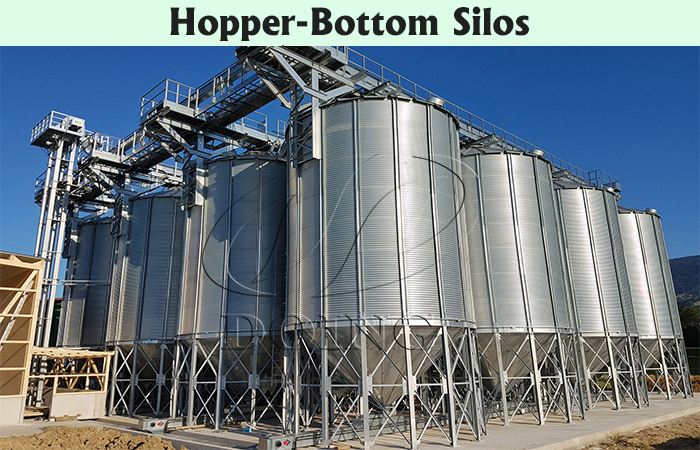 Hopper bottom silo
Advantages of Hopper Bottom Silos
Low maintenance– Grain empties completely without manual intervention or sweep augers. This reduces labor, prevents spoilage from residues, and means fewer moving parts – no post-cycle cleaning required.
Ideal for multiple grains– Perfect for farms that switch between corn, wheat, and soybeans. The self-cleaning design minimizes cross-contamination.
Space-saving discharge– The elevated outlet lets you park trucks or conveyors directly underneath, simplifying material handling.
Disadvantages of Hopper Bottom Silos
Higher initial cost due to the complex bottom structure.
Smaller maximum capacity per grain storage silo compared to flat bottom designs.
Typical capacity range:50–500 tons per silo
Discharge efficiency:gravity-driven, typically 20–40 tons/hour
As the name suggests, a flat bottom silo has a level concrete or steel floor. Grain discharge relies on sweep augers, conveyor systems, or pneumatic extraction units installed at the base. This grain storage silo design is often larger in diameter and commonly used for high-volume, long-term storage.
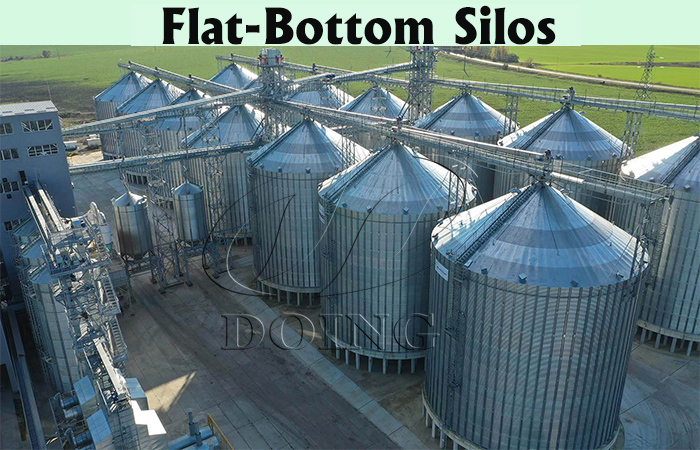 Flat bottom silos
Advantages of Flat Bottom Silos
Lower upfront investment– Simpler construction makes flat bottom silos more economical, especially for very large capacities.
Excellent for long-term storage– When grain stays in the silo for months, the flat bottom design pairs well with aeration floors to maintain grain quality.
Low-clearance friendly– Since discharge happens at ground level, you avoid the extra height of a hopper base.
Disadvantages of Flat Bottom Silos
Residual grain left on the floor requires cleaning and increases spoilage risk.
Slower discharge due to reliance on powered equipment (sweep augers or conveyors).
Typical capacity range:200–3,000+ tons per silo
Discharge efficiency:powered systems, typically 30–80 tons/hourdepending on equipment
Below, Jinrui Grain Silo provides a side-by-side comparison of hopper bottom and flat bottom silos in a table, helping you quickly understand their key differences.
| Feature | Hopper Bottom Silo | Flat Bottom Silo |
| Discharge method | Gravity (self-cleaning) | Sweep augers / conveyors (powered) |
| Residual grain | None | Left behind – requires cleaning |
| Best for | Multiple grain types (corn, wheat, soybeans) | Single grain, long-term storage |
| Initial cost | Higher | Lower |
| Capacity per silo | 50–500 tons | 200–3,000+ tons |
| Discharge efficiency | 20–40 tons/hour | 30–80 tons/hour |
| Best site clearance | Taller (hopper base adds height) | Low-clearance friendly |
| Cross-contamination risk | Low (self-cleaning) | Higher (residual grain) |
| Aeration compatibility | Limited to top aeration | Full aeration floor compatible |
| Maintenance cost | Lower (fewer moving parts) | Higher (sweep augers need upkeep) |
Which type of silo is better for farms that store multiple grain types?
Hopper bottom silos are the better choice if you rotate between corn, wheat, soybeans, or other grain types throughout the year. The gravity-driven self-cleaning design eliminates residual grain, minimizing cross-contamination between batches.
What is the typical capacity range for each silo type?
Hopper bottom silos typically range from50 to 500 tonsper unit. Flat bottom silos can store anywhere from200 to 3,000+ tons, making them more suitable for large-scale operations with long-term storage needs.
How do discharge speeds compare between the two silo types?
Hopper bottom silos discharge at20–40 tons/hourvia gravity, which is slower but consistent. Flat bottom silos with powered sweep augers or conveyors can achieve30–80 tons/hour, depending on equipment configuration.
Are flat bottom silos harder to maintain than hopper bottom silos?
Yes. Flat bottom silos leave residual grain on the floor that requires manual cleaning and increases spoilage risk. They also rely on sweep augers or conveyors, which have more moving parts and higher maintenance costs over time.
Can either silo type be equipped with aeration systems?
Flat bottom silos are fully compatible with aeration floors, making them the preferred choice for long-term grain storage where temperature and moisture control are critical. Hopper bottom silos typically support only top aeration, which is less effective for large-volume storage.
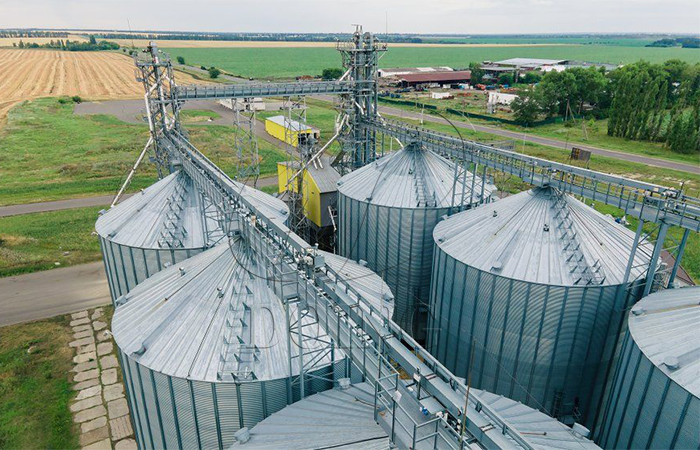 Selection of grain silos
Now that you’ve seen the differences, let’s match your operation to the right steel silo.
Choose a hopper bottom silo if:
You store different grains throughout the year (e.g., corn → wheat → soybeans)
You want to avoid manual cleaning and cross-contamination
You prefer lower labor costs over a slightly higher upfront investment
Your required capacity per silo is small to medium (under 500 tons)
Fast, clean grain turnover is a priority
Jinrui’s hopper bottom silos are engineered for efficient self-cleaning discharge, reducing labor and spoilage across multi-grain operations.
Choose a flat bottom silo if:
You mainly store one type of grain for months (e.g., rice, wheat in bulk)
Budget is a top priority and you need maximum capacity per dollar
You have low site clearance (no tall hopper base needed)
You already have sweep augers or aeration floors in place
Your operation requires 500+ tons per silo
Jinrui’s flat bottom silos offer reliable, large-volume storage with optional aeration systems for long-term grain quality preservation.
Now that you have a clear comparison between hopper bottom silos and flat bottom silos, the right choice comes down to your specific grain storage needs—whether you prioritize multi-grain flexibility and low labor, or large capacity and budget efficiency.
Contact Jinrui Grain Silo todayto discuss your grain storage project. Our team will help you select the most suitable steel silo and provide a free, customized quote. Send your inquiry now and let’s build the best grain storage solution for your business.
Share your needs & get a response within 24 hours!