



Storing wheat flour in a silo is fundamentally different from storing whole grain. Flour is hygroscopic, so it absorbs moisture from the air and cakes within days if humidity is not controlled. It traps heat because fine particles leave almost no air gaps. And unlike grain, flour dust is explosive — a single spark in the wrong conditions can destroy a silo.
These risks are manageable with the right approach. At Henan Jinrui, we have spent over 15 years designing flour storage systems across different climate zones. Based on that experience, here are six steps to store wheat flour safely in a silo long term.
Storing flour requires tighter sealing, better discharge design, and stricter safety measures than storing grain.
Airtight sealing. Moisture enters through the smallest gaps. Steel silos with EPDM rubber gaskets provide the level of sealing needed. Concrete silos are porous and can release moisture into stored flour over time.
Conical hopper bottom. Wheat flour compresses under its own weight. A hopper-bottom lets it discharge by gravity without mechanical assistance. Flat-bottom silos need sweep augers, which compact flour further and create dead zones where caking starts.
Explosion safety equipment. Flour dust is finer than grain dust and stays suspended longer — making it significantly more explosive. Every flour silo must include explosion venting panels, a dust collection system, and anti-static grounding. These are not optional.
In practice, the most suitable silo for long-term wheat flour storage is a bolted steel silo with a hopper bottom, EPDM gaskets, and integrated safety equipment. Silo height-to-diameter ratio also matters — a shorter, wider silo reduces compaction pressure on lower layers compared to a tall, narrow design.
 Grain silos for flour storage
Moisture is the single greatest threat to stored flour. Newly milled flour is loaded directly into a sealed silo and the temperature difference against the steel walls creates condensation. Water drips onto the wheat flour below, and wet spots turn into mold and crust within days. This is the most common preventable failure in wheat flour silo operations.
The correct sequence is: dry first, then store. For storage of three months or longer, flour moisture must be 13% or below. At 12% or lower, the risk of mold and caking drops to near zero. A grain drying system upstream of the silo brings moisture to the safe range regardless of conditions.
After drying, let the flour cool in a ventilated area for 24-72 hours before loading. Flour entering the silo should be within 3-5°C of the target storage temperature. Henan Jinrui supplies drying systems designed to integrate with the silo as a single workflow, matched to your crop type and local climate.
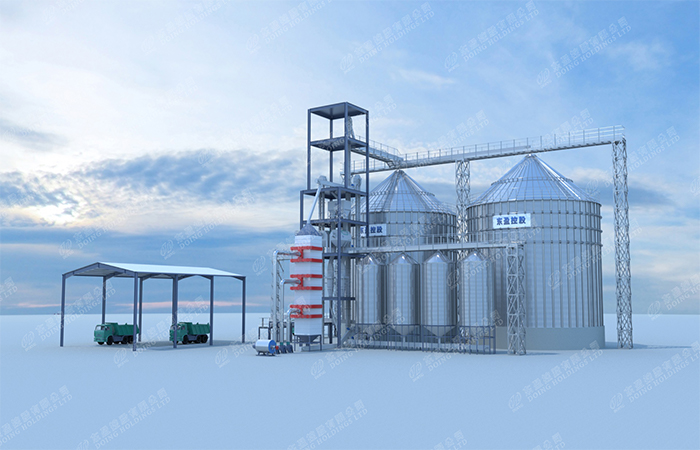 Grain drying system
Once the wheat flour is in the silo, two numbers determine how long it lasts.
Storage Targets
| Parameter | Target |
|---|---|
| Temperature | 18-24°C |
| Humidity | ≤60% RH |
| Flour moisture | 12-13% |
Warning Thresholds
| Condition | Temperature | Humidity | Risk |
|---|---|---|---|
| Warning | >30°C | >65% RH | Protein and starch degrade; baking quality drops within weeks |
| Critical | >35°C ambient | >70% RH | Visible mold can appear within 2-3 weeks |
Additional note: Below 18°C further slows biological activity. Even dry flour at 12% moisture releases moisture over time.
Ventilation is how you control both. The effective window is the coolest, driest hours of the night — typically 2:00-6:00 AM — when outside air is cool enough and relative humidity is below 65%. Airflow rate should be approximately 0.1-0.2 m³/min per tonne of stored material.
Ventilating at the wrong time makes things worse. Mid-day air is too hot. Evening air after rain carries moisture. In persistently humid climates, a dehumidifier in the silo headspace provides control independent of outside air.
Henan Jinrui offers automated control systems with integrated temperature and humidity sensors. The system activates fans only when conditions are favorable and internal readings require adjustment — saving energy while maintaining stable storage conditions.
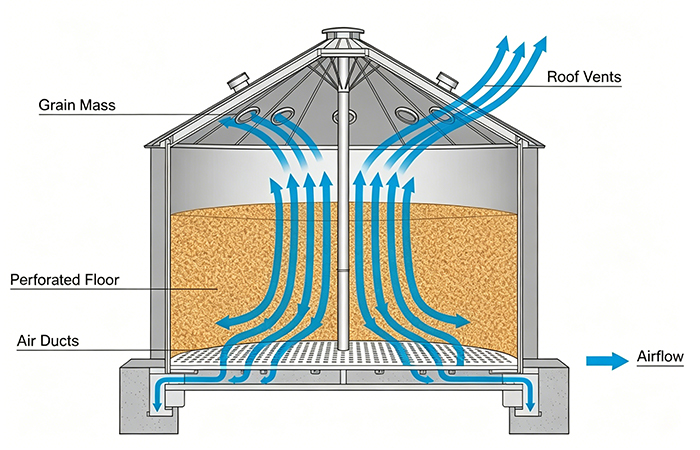 Wheat flour storage in a silo
Wheat flour attracts the same storage pests as grain — weevils, moths, and mites — but they are harder to detect because fine particles hide their activity. By the time pests are visible on the surface, the infestation is well advanced. Prevention handles the majority of cases.
For extended storage, additional methods are available:
Nitrogen atmosphere preservation — replacing oxygen with nitrogen (below 3-5% O₂) halts insect activity and mold growth without chemical residue. This is the standard approach for storage periods exceeding six months.
Food-grade inert dust — applied to interior surfaces before loading, it abrades insect exoskeletons without chemical residue. Used as a supplementary layer alongside other methods.
Phosphine fumigation — effective for active infestations, but requires full sealing and subsequent aeration, and does not prevent re-infestation. Henan Jinrui silos are designed with the airtight sealing needed for effective fumigation.
Flour in a silo needs regular attention. A consistent monitoring routine catches problems before they become losses.
Weekly checks:
Temperature at three depths (top, middle, bottom) — compare zones against each other
Moisture sample — compare against the loading value
Visual inspection of the surface layer — look for caking, crust, discoloration, or unusual odor
Monthly checks:
Pest traps inside the silo headspace
Ventilation fan function and filter condition
Dust collection system operation
Per batch:
Inspect all gaskets and seals before loading new flour
Maintenance actions for long-term storage:
Turnover: For storage over three months, transfer the flour periodically — either to a second silo or from bottom to top of the same silo. This breaks up compaction caused by the weight of the material above and redistributes moisture that has migrated within the mass.
FIFO rotation: The oldest flour must leave the silo first. Old stock remaining at the bottom while new stock fills from the top creates a quality gap that accumulates over time.
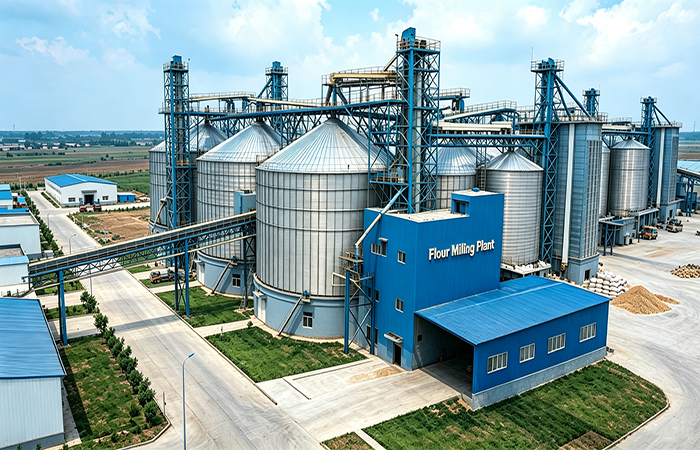 Flour stirage silos
Flour dust suspended in air is combustible. At the right concentration, an ignition source — a static spark, a hot bearing, a grinding wheel — can cause an explosion. This is the most serious operational risk in flour silo storage.
Required safety equipment:
Explosion venting panels designed to release pressure in a controlled direction
A dust collection system to keep airborne dust below explosive concentrations during loading and discharge
Anti-static grounding on all metal components — silo body, conveyors, ducts
Operational rules:
Strict no-hot-work policy near the silo during operation
Regular inspection of grounding connections and dust collection filters
Static dissipation verification before any maintenance activity
If you are converting a grain silo to wheat flour storage, have a qualified engineer review the explosion safety design before the first load.
Q: What is the safe moisture level for long-term flour storage in a silo?
A: For storage of three months or longer, flour moisture should be 13% or below. At 12% or lower, the risk of mold and caking is minimal.
Q: Can I use a standard grain silo for flour?
A: Grain silos can be used if they are modified with airtight gaskets, a hopper bottom (or retrofit sweep system), and explosion safety equipment. In most cases, a silo designed specifically for flour performs better and requires less modification.
Q: What temperature should a flour silo be kept at?
A: The practical target is 18-24°C. Lower temperatures extend shelf life further. Above 30°C, flour quality degrades measurably within weeks.
Q: What type of silo bottom is best for flour — hopper or flat?
A: Hopper-bottom silos are strongly recommended for flour. They allow gravity discharge without compaction and eliminate the dead zones that cause caking in flat-bottom designs.
Long-term wheat flour storage in a silo is not difficult when the system is designed correctly. The six steps in this guide cover the essentials: select the right silo, dry before loading, control temperature and humidity, prevent pests, monitor regularly, and protect against dust explosion.
Every project is different — your flour type, storage volume, and local climate all affect the right configuration. Henan Jinrui designs complete flour storage systems, from drying and conveying equipment to automated environmental controls, matched to your specific conditions. Contact us with your flour type, volume, and region, and we will prepare a preliminary silo layout with technical drawings and quotation within one business day.
Share your needs & get a response within 24 hours!