



Commercial grain operators face a recurring challenge: the right silo choice today determines storage efficiency, operational costs, and asset lifespan for the next two decades or more. Silo types vary across multiple dimensions — material, structure, connection method, and functional design — and each dimension carries cost, timeline, and performance implications.
Before comparing silo types, define what you need.
What will you store?
Different grains have different storage characteristics. Soybeans require stricter moisture control. Rice is sensitive to cracking. Mixed-grain operations may need separate silos for each grain type.
How much and how long?
Total capacity and storage period determine the scale and sealing requirements.
How often will you turn over the grain?
High-frequency turnover operations need automation-friendly designs. Low-frequency operations prioritize capacity and cost.
What are your site conditions?
Climate affects corrosion resistance requirements. Seismic zones impose structural constraints.
What is your budget and timeline?
Steel silos install faster and cost less upfront. Concrete silos have longer timelines but offer longer lifespan in certain conditions.
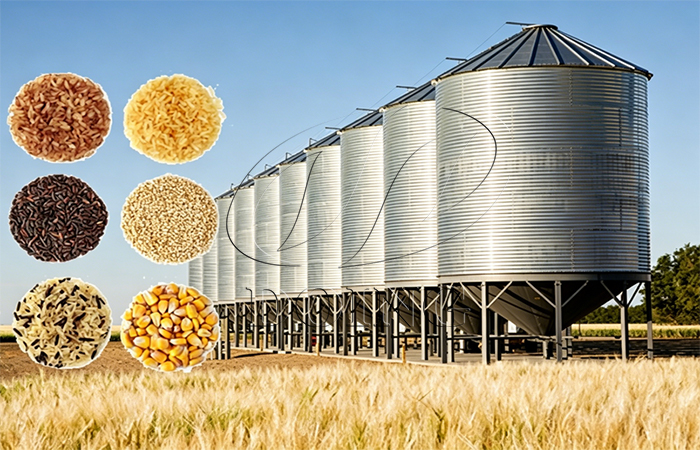 Grain silos for various grains
Commercial grain silos vary across four key dimensions. Each represents a decision point for the buyer.
By Material: Steel vs Concrete
Steel silos are prefabricated and assembled on-site, offering faster installation, lower upfront cost, and modular expandability. Concrete silos are cast in place, offering higher structural strength and longer lifespan in harsh environments, but at higher cost and longer timelines. For most commercial operations, steel provides the best balance of cost, speed, and performance.
By Structure: Flat-Bottom vs Cone-Bottom
Flat-bottom silos have a level floor and rely on sweep augers for complete discharge. They offer the lowest cost per ton and suit large-capacity, low-turnover operations. Cone-bottom silos have an angled floor allowing gravity discharge. They eliminate mechanical clearing and suit high-turnover operations where automation matters.
By Connection Method: Bolted vs Spiral-Seamed vs Welded
Bolted silos are easy to assemble, disassemble, and expand. Spiral-seamed silos provide excellent sealing with minimal gaps, suitable for fumigation-intensive operations. Welded silos offer the strongest structural integrity but require longer installation time.
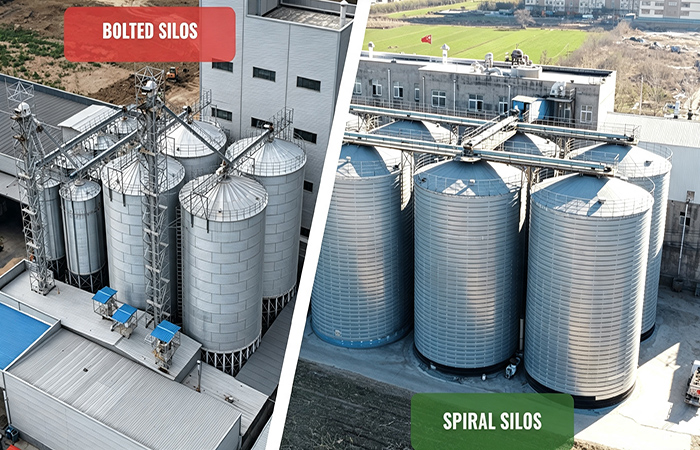 Bolted silo and spiral silo
By Function: Reserve vs Turnover vs Port-Terminal
Reserve silos prioritize capacity and sealing for long-term storage. Turnover silos prioritize automation and discharge efficiency for frequent loading and unloading. Port-terminal silos handle very high throughput with integrated conveying systems.
Among these dimensions, material and structure have the most direct impact on cost, performance, and longevity. The following sections examine each in detail.
Material choice shapes upfront cost, installation timeline, maintenance burden, and asset lifespan.
Steel Silos: The Mainstream Choice
Steel silos offer the best combination of cost, speed, and performance for most operations. Prefabricated in factories, they arrive as ready-to-assemble components. Installation takes weeks rather than months. The modular design allows incremental expansion.
The key quality indicator is the zinc coating. Hot-dip galvanized steel with 275g/m² zinc coating or higher provides reliable corrosion resistance for 20–25 years in most climates. In humid or coastal regions, higher specifications — 350g/m² or epoxy topcoats — extend lifespan further.
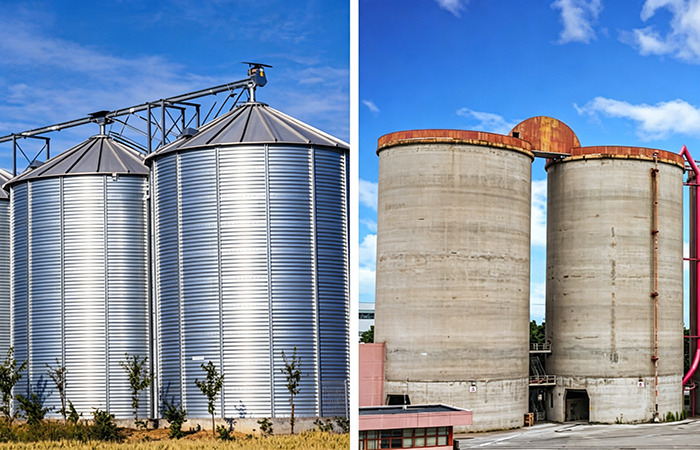 Steel silos and concrete silos
Concrete Silos: When Durability Outweighs Cost
Concrete silos suit specific scenarios: extreme humidity, saline air, or aggressive industrial environments. For strategic reserves intended to remain in place for 40–50 years, concrete's longer lifespan may justify the higher upfront cost.
The trade-offs are significant. Construction timelines are 6–12 months versus 2–4 months for comparable steel capacity. Cost per ton is typically 30–50% higher. Expansion is more difficult.
Material Decision Framework
| Factor | Recommended Type | Why |
| Budget or timeline constraint | Steel | Faster installation, lower upfront cost |
| Need for future expansion | Steel | Modular design allows incremental growth |
| Extreme humidity or saline air | Concrete | Better corrosion resistance in harsh environments |
| Strategic reserve (40+ years) | Concrete | Longer lifespan justifies higher investment |
| High-turnover commercial operation | Steel | Balance of cost, speed, and performance |
Once material is decided, the next question is structure: flat-bottom or cone-bottom.
Flat-Bottom Silos: Capacity and Cost Efficiency
Flat-bottom silos have a level floor. Complete discharge requires a sweep auger. They offer the lowest construction cost per ton of storage and are best suited for large-capacity, low-turnover operations.
Cone-Bottom Silos: Automation and Turnover Efficiency
Cone-bottom silos have an angled floor — typically 45° to 60° — allowing grain to flow out completely by gravity. No sweep auger is needed. This design enables faster, more automated turnover, reducing labor and cycle time. The trade-off is higher cost and limited maximum diameter for very large capacities.
Structure Decision Framework
| Factor | Recommended Type | Why |
| Capacity above 5,000 tons per silo | Flat-bottom | Lower cost per ton at large scale |
| Low turnover frequency (1–2x per year) | Flat-bottom | Mechanical clearing is manageable |
| Budget priority | Flat-bottom | Lowest construction cost |
| High turnover frequency (weekly or daily) | Cone-bottom | Gravity discharge enables automation |
| Automation priority | Cone-bottom | No sweep auger needed |
| Limited labor for clearing operations | Cone-bottom | Reduces manual intervention |
Material and structure are the two most consequential decisions in silo selection. Steel silos offer the best balance of cost, speed, and flexibility for most commercial operations. Concrete silos justify their higher cost in extreme environments. Flat-bottom designs maximize capacity. Cone-bottom designs enable automation.
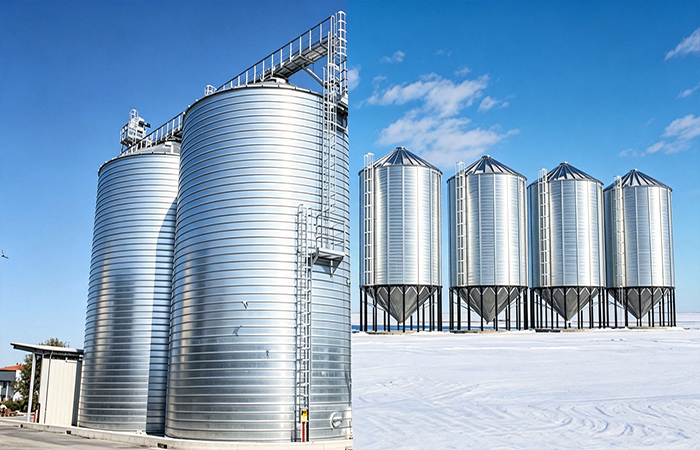 Flat-bottom silos and cone-bottom silos
Jinrui Grain Silos manufactures commercial grain storage systems worldwide, from design through installation and commissioning. Contact us for a project-specific consultation.
Q1: How do steel and concrete silos compare in total cost of ownership?
A: Steel silos typically have lower upfront cost and faster installation. Concrete silos have higher upfront cost but may offer lower maintenance cost in extreme environments. The break-even point depends on your climate, storage duration, and maintenance practices.
Q2: Can I mix flat-bottom and cone-bottom silos in the same facility?
A: Yes. Many commercial facilities use a combination — flat-bottom silos for bulk storage and cone-bottom silos for high-turnover grains. This approach balances capacity, cost, and operational flexibility.
Q3: What factors affect the lifespan of a galvanized steel silo?
A: Zinc coating thickness, local climate, and maintenance practices are the three key factors. Regular inspections, prompt repair of damaged coatings, and proper ventilation extend service life beyond the typical 20–25 years.
Q4: What site preparation is required before silo installation?
A: A reinforced concrete foundation is standard for both steel and concrete silos. Soil bearing capacity, drainage design, and seismic requirements must be assessed. Site access for construction equipment and future grain handling systems should also be planned.
Q5: How do I plan for future expansion when designing a silo facility?
A: Leave space for additional silos, design foundations and conveying systems with expansion capacity, and choose bolted steel silos for easier reconfiguration. Initial planning reduces retrofit costs by 30–50% compared to retrofitting an unplanned facility.
Q6: Does Jinrui Grain Silos provide installation support?
A: Yes. Jinrui Grain Silos supplies installation guidance, on-site technical supervision, and commissioning support for all commercial silo projects. We also offer customization services to tailor your grain silo system to your specific needs.
Share your needs & get a response within 24 hours!