



Summer grain storage spoilage is driven by three factors: excess moisture, high temperatures, and insect activity. Control all three, and you control spoilage. According to the FAO, roughly one-third of all food produced globally is lost or wasted — and improper summer storage is a leading contributor in hot climates. The good news: most of these losses are preventable.
Here are five proven strategies, provided by Henan Jinrui, a leading designer and exporter of grain storage systems, for grain silo maintenance during hot weather.
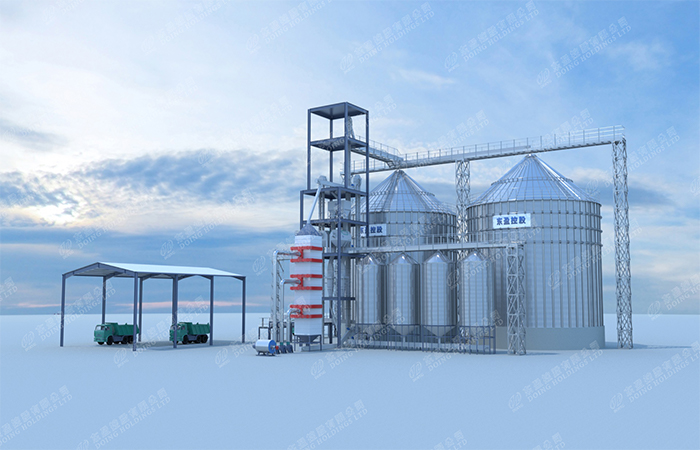 Grain drying system
Moisture is the single biggest threat to summer grain storage. When grain with excess moisture enters a silo, mold respiration begins almost immediately, generating heat that compounds the problem. At ambient temperatures above 35°C, wet grain can begin to spoil within days.
Safe moisture thresholds vary by grain type. For maize and corn, keep moisture at 14% or below — levels above 15% accelerate mold risk rapidly. For wheat and soybeans, the threshold is 12% or below. For paddy rice, 14% or below is the standard. These levels are typically 1–2% lower than winter storage guidelines due to higher biological activity in warm weather.
Standard practices: Verify every batch with a calibrated moisture meter before loading. Grain must be processed by grain drying system to the target level before entering the silo, regardless of weather conditions. For high-throughput operations, automated moisture sorting at the receiving pit adds an extra layer of quality control.
 Grain silos
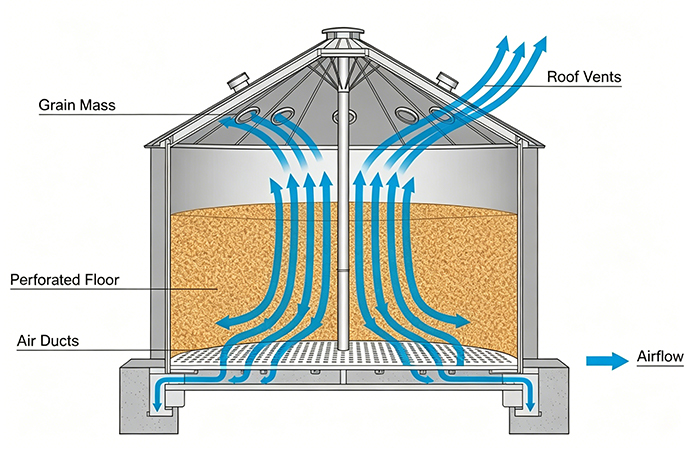
Many operators run aeration fans during the day simply because that is when staff are on-site. But daytime air in summer is typically hot and humid — pumping it into a silo can add heat and moisture rather than removing them. A properly designed silo aeration system should be set to cool, not to heat.
For effective cooling, schedule aeration during the coolest hours of the night, between 2:00 AM and 6:00 AM, when ambient temperatures are in the 20–25°C range and relative humidity is 55–65%. To see why this matters, compare the three aeration windows:
| Window | Temp | RH | Effect on Stored Grain |
| Mid-day (35–42°C) | Hot | 30–50% | Adds heat, limited drying benefit |
| Evening (28–32°C) | Warm | 65–80% | Risks adding moisture to grain surface |
| Night (2–6 AM) | Cool (20–25°C) | 55–65% | Optimal cooling and moisture removal |
Standard practices: Aerate during the coolest 4–6 hours of the night. Maintain airflow of 0.1–0.2 m³/min per tonne of grain (ASABE standard). Never aerate during or after rainfall. Log ambient conditions before activating fans.
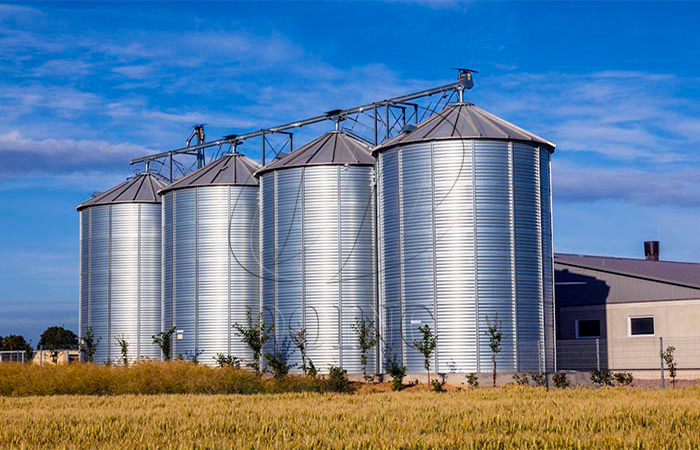 Grain storage system
Temperature changes inside a silo often go unnoticed until visible spoilage has already occurred — which is why thermometer-based grain silo maintenance is so critical. Solar radiation heats the top layer and sun-facing wall, while respiration generates heat at lower depths. A developing hot spot can be active for a week or more before it is detectable at the surface.
Install temperature cables at three depths per silo compartment: one-third from the top for early detection of surface moisture ingress, at the midpoint to monitor core respiration activity (the most critical zone), and near the bottom to confirm aeration is reaching full depth.
Warning signs:
| Reading | Likely Cause | Action Required |
| More than 5°C above ambient | Active spoilage | Investigate immediately |
| More than 2°C between zones | Uneven aeration or developing hotspot | Check fan operation |
| 3°C rise within 48 hours | Insect activity or mold growth | Inspect and treat |
Standard practices: Check at least weekly in summer, ideally early morning before solar heating of the silo surface masks hot spots. Log all readings and compare with previous measurements to identify trends. Respond immediately when any threshold is exceeded.
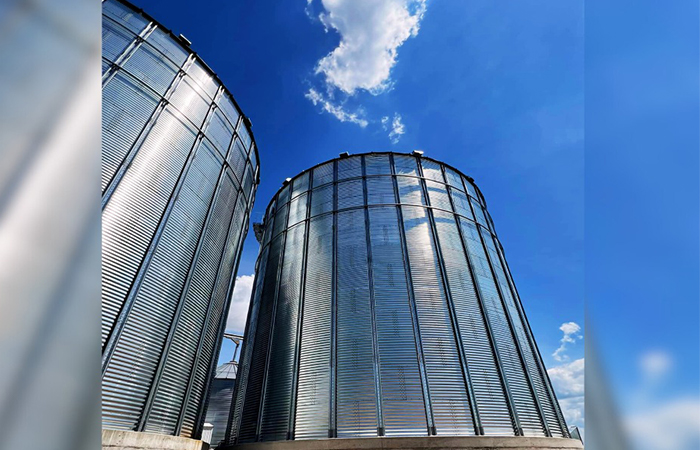 Grain steel silos
A single fumigation treatment for a 500-tonne silo costs $800–1,200 — a significant grain fumigation cost that easily exceeds a full preventive cleaning program, which runs roughly $150–300 per cycle. The economics are clear, yet many operators overlook cleaning as a routine part of grain silo maintenance.
Before each fill cycle: Vacuum or sweep all interior surfaces — walls, floor, and aeration ducts. Clean discharge augers and boots thoroughly; these are the most common pest harborage points in any facility. Run the aeration system empty for 30 minutes to clear duct residue.
Inspection cadence: Checkloading hatch gaskets monthly, inspection port seals before every fill, panel joints annually, and aeration duct covers each season. Replace worn gaskets immediately — a failed seal can undo every other prevention effort.
A note on silo type: Hopper-bottom silos naturally discharge fully, leaving minimal residual grain, making them easier to clean and less attractive to pests. Flat-bottom silos require sweep augers and manual floor cleaning. If you operate flat-bottom silos in a hot climate, budget for at least two full cleanings per year.
Additional measures: Apply grain-safe insecticides to walls and floor in accordance with local regulations. Install controlled-release insecticide strips in the headspace.
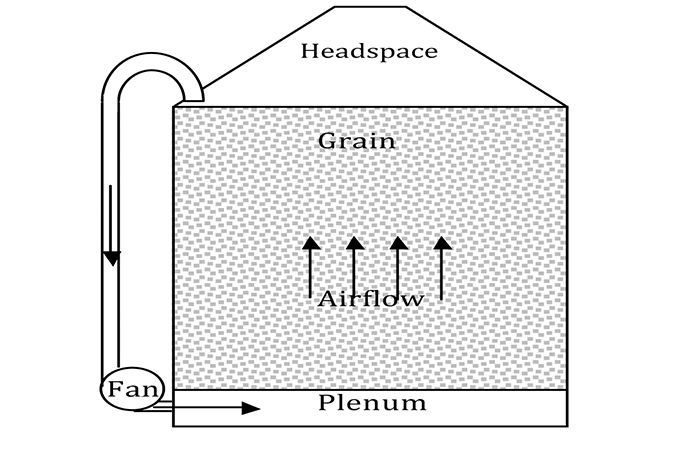 Summer grain storage
Solar radiation heats the silo roof and transfers into the top grain layer. Combined with warm air rising from lower levels, condensation forms on the grain surface — the starting point for crusting, caking, and mold.
For silos under 100 tonnes, manual turnover with a shovel or bucket every two weeks is sufficient. For 100–500 tonnes, use a small auger extraction and re-injection every two to three weeks. For silos over 500 tonnes, manual methods are not practical — install a fixed recirculation system operating bi-weekly or triggered by temperature changes.
Turn over the top 30–50 cm of grain and inspect condition during the process. Look for changes in color, odor, and temperature. Reduce the interval if surface condensation or temperature spikes are observed. Periodic turnover breaks surface crust, redistributes moisture from condensation zones, and aerates the top layer without running the main aeration system.
Across all five strategies, the common thread is equipment designed to work together. We supply integrated grain drying systems that hit target moisture before grain enters the silo. Our automated aeration controllers activate fans only during optimal night conditions, reducing electricity use while preserving grain quality. Wireless temperature monitoring systems track conditions at multiple depths and push real-time alerts to your phone or control room, integrating with existing SCADA infrastructure for large terminals.
Our silos use EPDM rubber gaskets rated for extreme temperature cycling (-20°C to +60°C) and corrosion-resistant Galvalume steel panels that are easier to clean than traditional painted steel. For grain turnover, we offer recirculation and spreader systems — for flat-bottom silos, sweep augers combined with top-fill spreaders automate the full cycle from a single control panel.
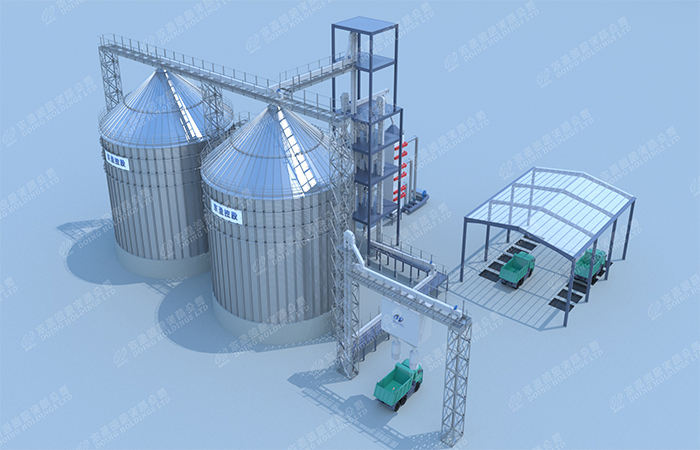 Henan Jinrui grain silos
Q: What is the ideal moisture content for summer grain storage?
A: Corn: ≤14%. Wheat and soybeans: ≤12%. Paddy rice: ≤14%. These are 1–2% lower than winter guidelines due to higher biological activity in warm weather.
Q: Is it safe to run aeration fans during the day in summer?
A: Generally, no. Daytime air is too hot and often humid. The optimal window is 2:00–6:00 AM. Automated controllers handle this without requiring night staff on-site.
Q: What temperature changes should trigger investigation?
A: Any zone reading more than 5°C above ambient, or a sudden 3°C rise within 48 hours. Temperature cables at three depths enable early detection — waiting for surface-level signs often means damage is already done.
Q: How do grain silos perform in hot climates — isn’t the metal roof a problem?
A: Silos with reflective coating and properly sized aeration systems manage internal temperatures effectively even in hot climates. The key is correct system design for the specific climate — what works in Egypt’s dry heat does not work in Thailand’s humid heat.
Q: What is the most common oversight in summer grain storage?
A: Underestimating the cost of spoilage. A single incident in a 500-tonne silo can cost $30,000–50,000, far more than the $3,000–8,000 preventive investment in proper equipment. A close second is running aeration during the day, which feels productive but can worsen storage conditions.
Whether you need a single on-farm silo or a multi-unit commercial terminal, Henan Jinrui engineering team can provide preliminary silo sizing based on your grain type, volume, and regional climate, technical CAD drawings, and a detailed quotation within 24 hours.
To request a consultation, please provide your grain type(s), expected storage volume per cycle, geographic region or climate zone, and any existing storage infrastructure. We will respond within one business day.
Share your needs & get a response within 24 hours!