


Every time grain moves inside a grain storage system—unloading, elevating, conveying, or loading—dust is created. Fine particles, broken kernels, and foreign materials become airborne. Without proper control, that dust doesn‘t just settle on surfaces. It creates explosive hazards, degrades grain quality, and puts facilities at risk of regulatory non-compliance.
That’s why a well-engineered dust collection system is not optional for modern grain silos. It‘s essential.
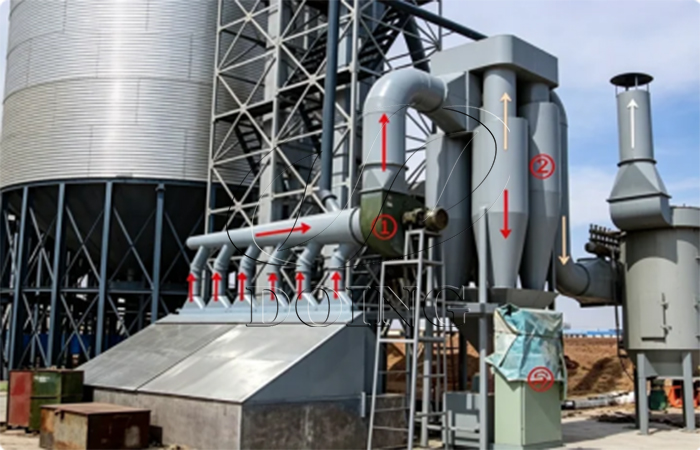 Dust collector system for grain pre-cleaning
A dust collection system is not just a machine—it‘s an engineered network that protects your grain storage system from the inside out. Understanding how it works helps you make the right investment for your grain silos.
The principle is simple but precise. At every point where grain moves—unloading, lifting, dropping, or loading—dust is released. A well-designed dust collection system does three things:
Capture – Hoods and enclosures are placed directly at dust sources (receiving pits, elevator boots, transfer points, silo vents). They create negative pressure that pulls dust into the ductwork before it can escape into the grain silos.
Convey – Ductwork transports dust-laden air to the central collector. Proper airflow velocity keeps particles suspended, preventing settling and blockages.
Collect – Inside the collector, cyclones spin out heavier particles using centrifugal force, while pulse jet filters trap fine dust on fabric bags. Clean air is exhausted or recirculated; collected dust is either returned to the grain stream or safely discarded.
This continuous process maintains a clean, safe environment inside your grain storage system without interrupting daily operations.
 Henan Jinrui dust collector system
Not every part of a grain silo needs the same level of dust control. But these high-risk zones demand dedicated dust collection system:
Receiving pits – When trucks or railcars unload, massive dust clouds form. Capture here prevents fugitive emissions and protects workers.
Bucket elevators – As grain cascades between buckets, dust escapes at the head and boot. Collection here is non-negotiable for safety and cleanliness.
Conveyor transfer points – Every time grain changes direction or drops from one belt to another, dust is generated. Enclosed transfer points with proper hoods control this constant source.
Silo vents – During filling, air rushes out of grain silos, carrying fine particles. Vent collection ensures clean air exits your facility.
Load-out spouts – When loading trucks or railcars, dust can engulf workers. Capture hoods at spouts protect your team.
These locations represent the full grain handling pathway—from arrival to departure—within any modern grain silos.
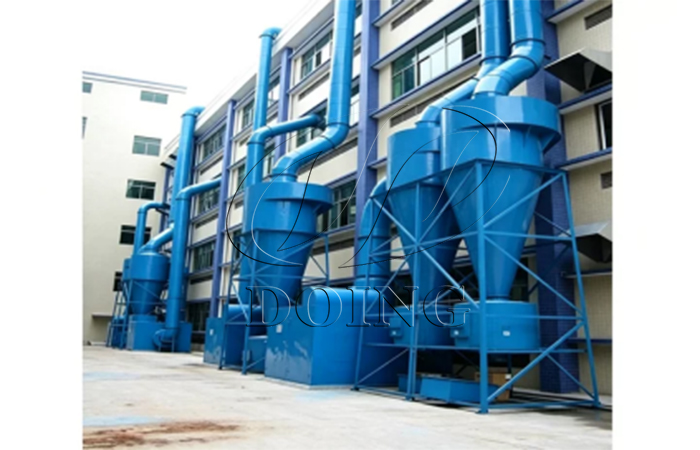 Dust collector system for grain storage
Henan Jinrui designs dust collection systems for grain storage system with three priorities: efficiency, durability, and ease of maintenance. Here‘s what sets our approach apart for your grain silos and grain handling operations:
Source capture: We place hoods as close as possible to dust generation points within your grain storage system. This minimizes the volume of air that needs to be moved, reducing energy costs and improving capture efficiency—keeping your grain silo environment cleaner and safer.
Smart ductwork layout: Duct runs are kept short and direct to optimize dust control in your grain storage facility. Where turns are unavoidable, we use smooth radius elbows rather than sharp angles to prevent particle buildup and pressure loss. All ductwork is independently supported—never resting on fans or other equipment—to maintain alignment and prevent vibration damage, ensuring long-term reliability for your grain handling system.
Two-stage filtration for real-world dust: Cyclones remove larger, abrasive particles first, protecting downstream pulse jet filters from premature wear. This extends filter bag life and reduces maintenance frequency, delivering consistent dust collection performance across your grain silos.
Pulse jet cleaning: Our dust collection systems clean themselves automatically. When pressure drop reaches a set threshold (typically 1200–1500 Pa), a burst of compressed air pulses through each filter bag, dislodging accumulated dust into the hopper. Cleaning cycles are sequential, so your grain storage operation never shuts down—maintaining continuous grain handling without interruption.
Built for grain-specific hazards: Every component is selected with food-grade materials and explosion-proof features. This means safer operation in grain silo environments where combustible dust is a real risk, protecting both your grain storage facility and your personne.
At Henan Jinrui, we don‘t just supply dust collection equipment. We design complete grain storage solutions that integrate cleaning, conveying, drying, and storage into seamless turnkey systems.
Whether you need a standalone collector for a single silo vent or a comprehensive grain storage system for a large facility. Every system is designed with food-grade materials, explosion-proof features, and the durability required for demanding grain silos. Ready to improve dust control in your grain storage operation? Contact Henan Jinrui‘s engineering team to discuss your application—we’ll help you design a customized grain storage solution.
Share your needs & get a response within 24 hours!